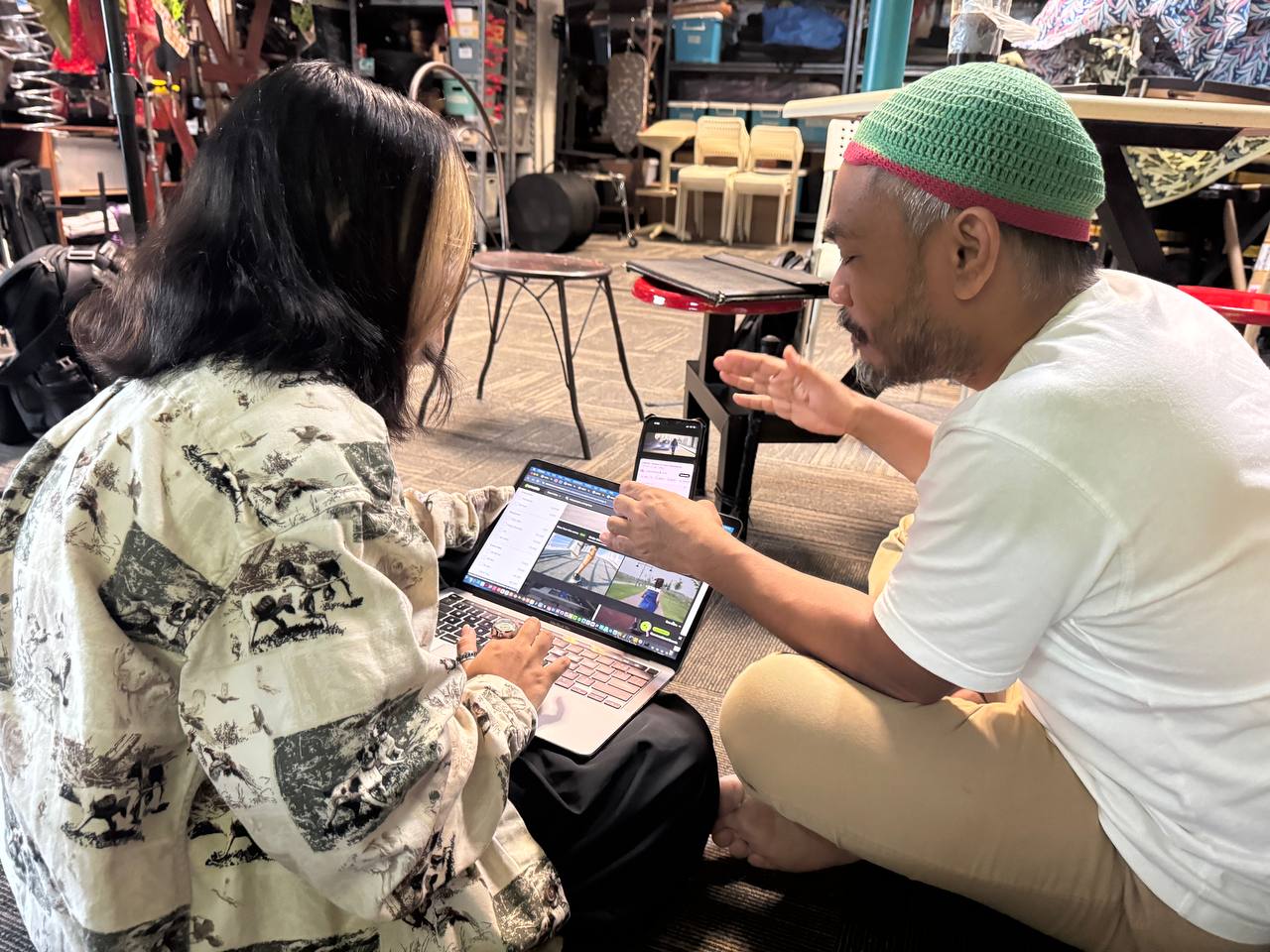
I spent this week doing ethnographic research. I moved out of my theoretical bubble and spoke to an actual Artistic Director in the Malay percussion scene.
I went in with the assumption that perhaps they did not use visuals because they didn't know what they wanted. I was incorrect. They have incredibly specific and meaningful visual ideas. They want "wild" aesthetics and non-literal interpretations.
The problem is purely instrumental. Current software affords infinite complexity but zero immediacy. It forces them to become technicians which detaches them from their practice.
WEEK 8
Hypothesis Correction
Performers know exactly what they want (high-quality, abstract, "wild" visuals). The hypothesis failed, proving the problem is affordance (software complexity), not lack of vision.
Technical Pivot
Using Blender's particle simulations and the EEVEE engine to create organic, cinematic visuals. This tested if high-fidelity visuals could be generated by simple front-end variables.
The Backend Strategy
Performers require cinematic, high-fidelity aesthetics. The complexity must stay hidden in the code (Blender simulations), allowing the user interface to remain simple.
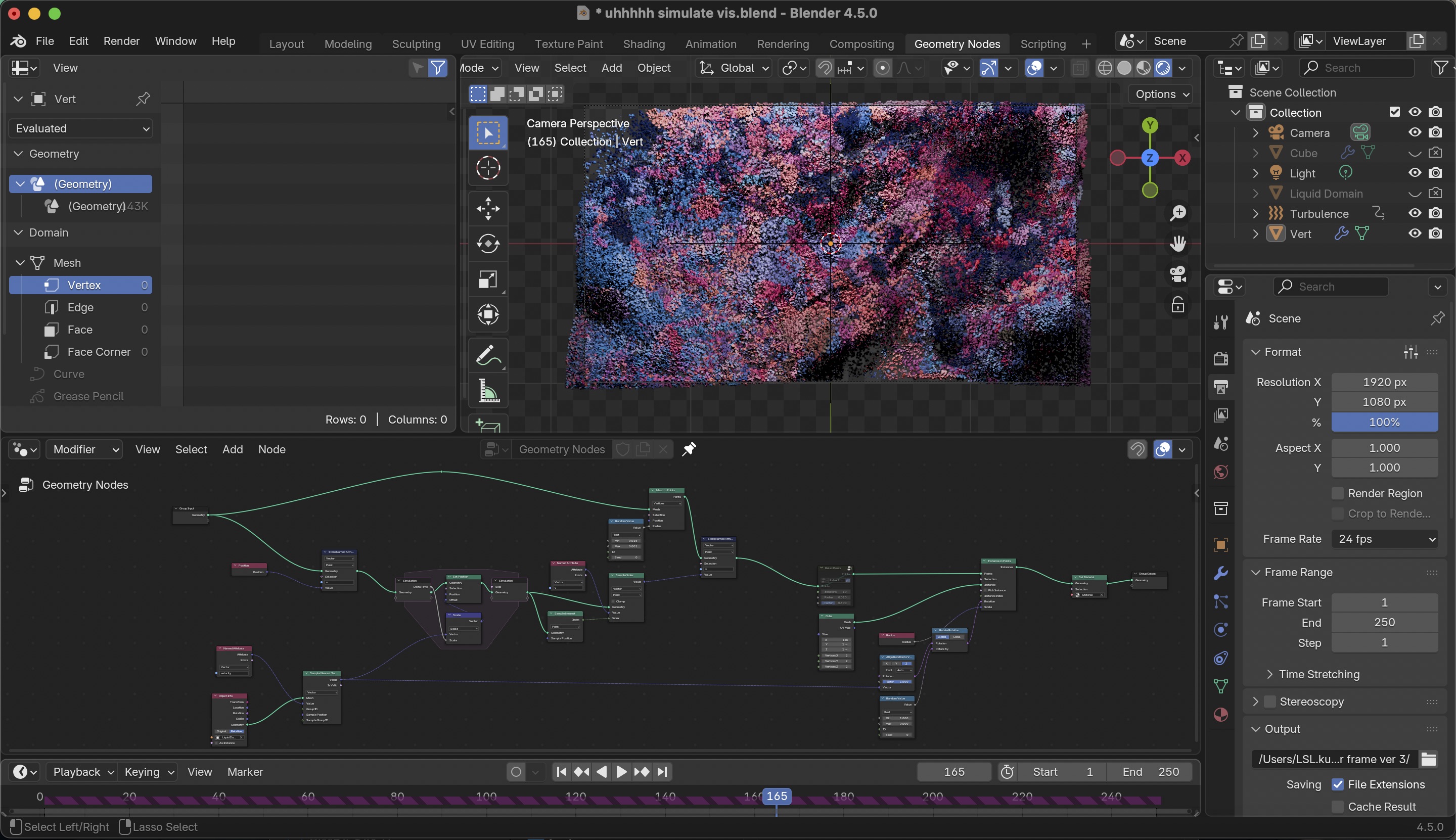
To address this requirement for abstract but meaningful visuals, I began Experiment 3.1. I dove into Blender and its particle simulations. I focused on using the EEVEE rendering engine to create visuals that felt organic rather than geometric.
I wanted to see if I could create a system where the chaos of the visuals could be controlled by a simple variable. The goal was to prove that professional aesthetics could be generated without the user needing to touch a single node in the software.
This experiment was also a test of my own technical limits. I have never used Blender simulations before so I had to learn on the fly. I realized that the "quality" of the visual is very important to these performers. They do not want low-resolution pixel art. They want something that looks cinematic.
By using Blender, I can achieve that high-fidelity look that connects better with their artistic standards.
The result was a series of wild visual states that aligned much better with the performers' descriptions. I created simulations that looked like swarms or flowing water. This confirmed that the software backend needs to be powerful so that the frontend interface can remain simple.
The complexity stays in the code so the user does not have to see it. This directly addresses the critique of instrumental affordances identified in the ethnographic phase.