Sem 2 is dramatically different from Sem 1. Sem 1 was a lot of spiralling in theory and genuinely not knowing what I was making, this semester I at least know the direction. The project is Visual Harmonics: a physical controller for performers that feeds into a real-time reactive visual system. The research method is Research through Design (RtD), which means the making is the research. That suits me a lot better than Sem 1's constant 'but what does this mean theoretically' energy.
The goal is to make real-time visuals accessible to creative practitioners, specifically performers. Not accessible in the disability sense, accessible in the sense of: you shouldn't need to be a coder to have reactive visuals respond to your performance. The Nadi Singapura interview crystallised this for me. What performers want isn't just reactivity, it's transparency. The tool needs to disappear so they can focus on the craft.
WEEK 1
13-16 January 2026
Research through Design
Confirmed this week. Not Critical Making, RtD. The making is the inquiry. Building sensor-based interfaces, testing with performers, using feedback to inform the next iteration.
Interview
A performer from Nadi Singapura, traditional Malay percussion group. Confirmed performers want reactive tools, but need low cognitive load. The tool has to feel transparent mid-performance.
Clarifying Direction
Research over the break: Shadertoy, SENSORBAND, FFT audio spectrum in Blender geometry nodes. Week 1 was mostly absorbing it all and trying not to spiral.
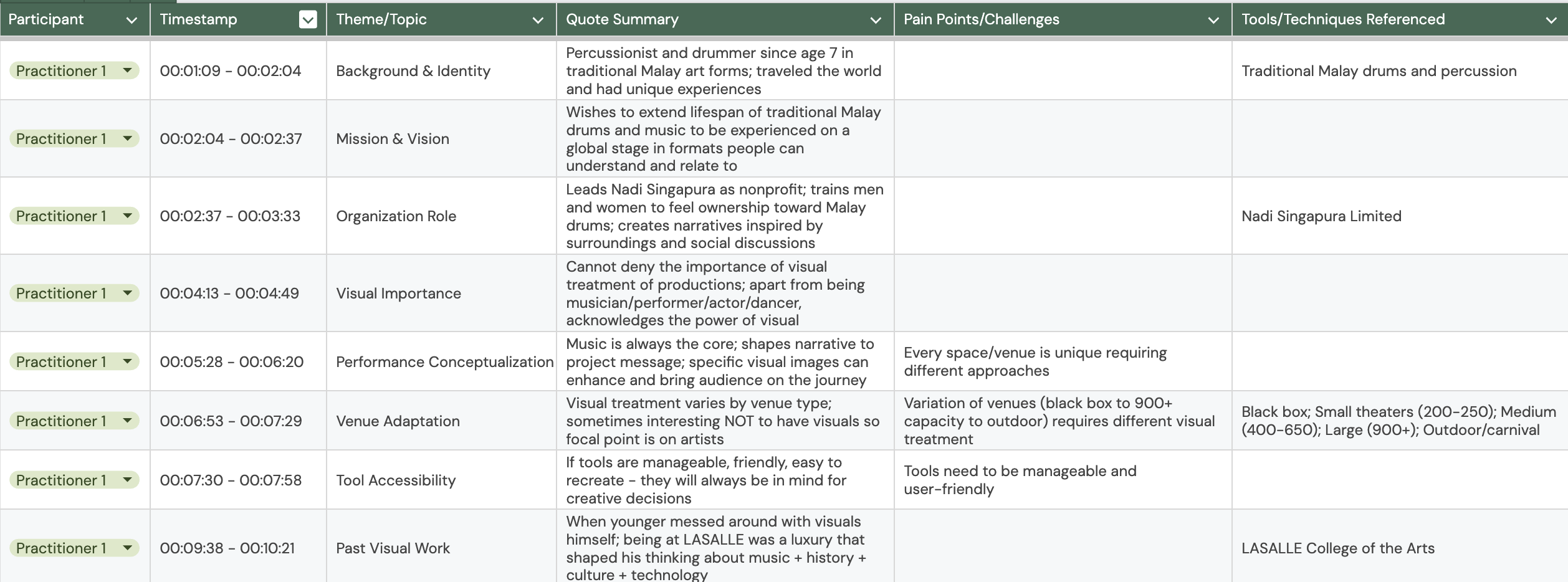
First session back was a dissertation consultation. I came in with the Nadi Singapura interview transcript, I'd done the interview over the break, and we worked through what it actually meant for the project.
The performer I spoke to is a percussionist with a deep background in traditional Malay arts who leads the group. What came out of the conversation was kind of exactly what I'd hoped but also more specific than I expected. They don't want to be managing a controller mid-set. The tool needs to be responsive enough to be useful but transparent enough that it doesn't create cognitive load. So it's not just 'make audio-reactive visuals', it's 'make something so intuitive the performer doesn't notice they're using it.' That's a more precise design brief.
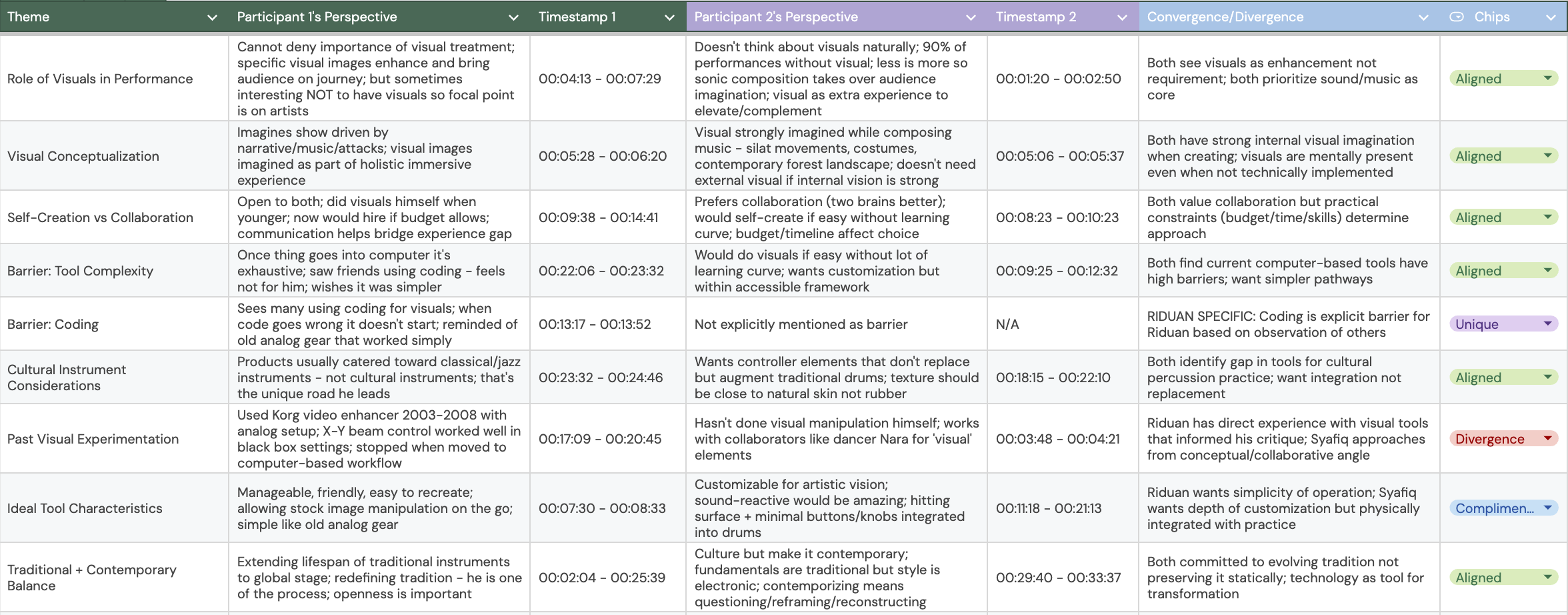
Practitioner Interview - Thematic Breakdown
Convergence and divergence between Riduan and Syafiq's perspectives on visual manipulation and performance practice.
| Theme | Riduan's Perspective | Syafiq's Perspective | Alignment Analysis | Status |
|---|
The disintegration of
Critical Making
in the dissertation.
Naming it properly was the thing that unlocked the writing. Once the framework was right, the dissertation had somewhere to go. The making was always the inquiry, it just needed the correct label.
Also this week: we officially settled that the research method is Research through Design. Not Critical Making. I'd been trying to shoehorn the project into Critical Making in Sem 1 and it never quite fit. What I'm doing is building sensor-based interfaces, testing them with performers, and using that feedback to inform the next iteration. The making is the inquiry. RtD is right, and naming it properly made the dissertation feel a lot more writable.
My notes just say 'I was just overwhelmed' for Friday and yeah, that tracks. Week 1 back and there was already so much in the air: dissertation to write, prototyping to start, user testing to organise, the Blender and TouchDesigner work, and figuring out how any of it connects into one coherent project. Unlike Sem 1 where confusion was expected, there's less runway now. The making has to be deliberate.
Some comments that Andreas gave to continue on my research were:
the User Testing?"
the User Testing?"
the success?"
the success?"
with the Prototype?"
with the Prototype?"