CHAPTER 4
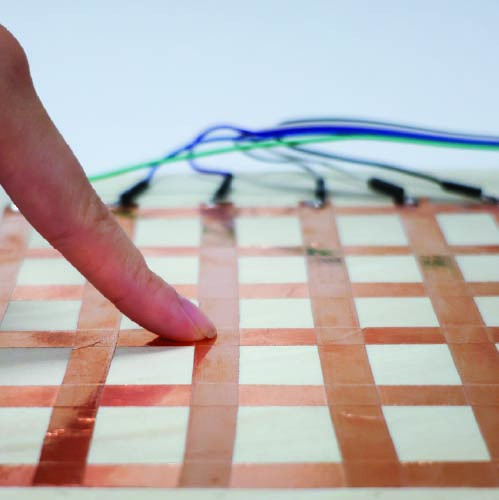
Chapter 4 is about finding the right sensor. Experiment 4.1 tests capacitive touch, detecting skin contact without pressure, using copper tape wired to an MPR121 breakout board. The concept is strong but the execution proves noisy and unreliable. Experiment 4.2 makes the pivot: piezo electric sensors, which detect vibration and physical impact, and output a continuous analog signal proportional to hit force. The key discovery here is resistor calibration, a 10MΩ resistor turns out to be the sweet spot for a clean, sensitive signal.
EXPERIMENT 4.1
Process: Explored the MPR121 sensor to detect skin contact without pressure. Created multiple touch zones on a non-conductive surface.
Construction: The prototype grid used copper tape wired to the breakout board, creating a dense matrix of touch zones.
Conclusion: Technically difficult. Custom wiring and capacitive sensitivity led to high noise and unstable data. The concept is strong, but execution requires refinement for reliability.
EXPERIMENT 4.2
Pivot: Shifted to Piezo sensors, which detect vibration and physical impact. Unlike buttons, Piezo outputs a continuous analog value proportional to hit force.
Calibration: Tested resistor values to "tune" the sensor. High resistance = noise; low resistance = dead signal.
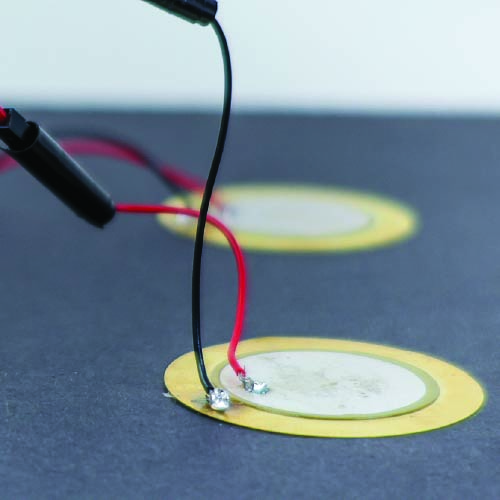
Results: Discovered that a 10M ohm resistor was the perfect solution. It maximized voltage reading while keeping the signal clean, allowing detection of subtle vibrations.